 UAE BARQ برق الإمارات – نبضك
His Highness Sheikh Mohammed bin Rashid Al Maktoum, Vice President, Prime Minister, and Ruler of Dubai, affirmed that preserving the nation’s history and safeguarding its cultural heritage is a national responsibility that reflects pride in its roots and a commitment to ensuring that its stories and values remain deeply embedded in the hearts and minds of future generations. H.H. noted that Al Fahidi Fort embodies this historical and civilisational legacy. For more than 230 years, the Fort stood as a formidable stronghold and protector of Dubai, witnessing its beginnings and transformations. It played a pivotal role in defending the city and served as its seat of government. Today, it stands as a cultural landmark that preserves the emirate’s memory and chronicles the milestones of its journey, from its origins along Dubai Creek to its emergence as a global city.
H.H. Sheikh Mohammed said: “Al Fahidi Fort connects generations to Dubai’s history through a museum and cultural experience that highlights the civilisational and human values that shaped our society. It offers our children an opportunity to discover the foundations upon which the emirate was built and the lessons and experiences of its past.”
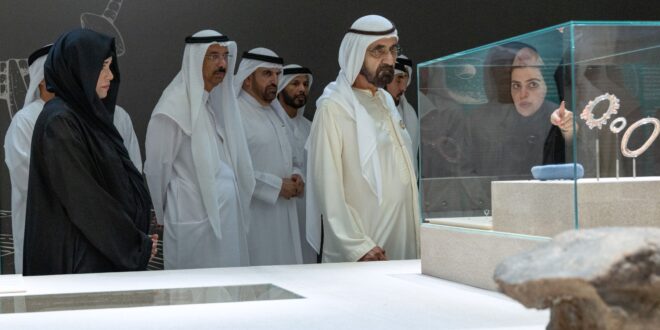
H.H. made these remarks during a visit to Al Fahidi Fort Museum, Dubai’s oldest standing historic building and its first museum. Following its comprehensive restoration and redevelopment, the landmark offers an interactive museum experience that combines historical artefacts with immersive displays. The museum traces Dubai’s origins and stages of development, inviting visitors from around the world to explore the emirate’s history and defining milestones.
H.H. said, “Our museums are cultural beacons that preserve our memory and tell the story of a people who held firmly to their values and built their nation with determination and resolve. Today, we reopen the doors of Al Fahidi Fort so it can remain a living landmark that tells the story of Dubai and its people. We want our children to know where we began, and the world to discover our culture and history, from which we draw strength to continue building and shaping the future.”
H.H. added, “Dubai has long been a meeting place for traders and a destination for those seeking a better life and promising opportunities. It will continue to be a home for cultures and a centre for human and civilisational exchange.”
H.H. was accompanied on the visit by Mattar Al Tayer, Director General and Chairman of the Board of Executive Directors of the Roads and Transport Authority (RTA), and Chairman of the Supreme Committee for Urban Planning in Dubai; Helal Saeed Almarri, Director General of the Dubai Department of Economy and Tourism; Mohammed Ahmed Al Murr, Chairman of the Board of Directors of the Mohammed bin Rashid Al Maktoum Library Foundation; Hala Badri, Director General of Dubai Culture and Arts Authority; and Jamal bin Huwaireb, CEO of the Mohammed bin Rashid Al Maktoum Knowledge Foundation.
H.H. Sheikh Mohammed bin Rashid Al Maktoum toured the Fort, exploring its galleries, exhibitions and collections, including documents and archival materials, interactive digital media and audiovisual experiences tracing the Fort’s history, evolving roles and transformations from its construction in 1787 to the present day.
During the tour, H.H. viewed several of the museum’s most significant artefacts, which document different chapters of Dubai’s history and offer visitors insights into ways of life, traditional crafts, industries and cultural exchange across the region over time.
H.H. also visited The Vault, an immersive museum experience that traces the development of defence in Dubai and the UAE, as well as H.H.’s contribution to its evolution. The gallery features pieces of H.H.’s military uniform, communications equipment and military musical instruments, alongside weapons and equipment used in Dubai and the UAE across different periods. Together, these objects document key stages in the development of the country’s defence capabilities.
H.H. Sheikha Latifa bint Mohammed bin Rashid Al Maktoum, Chairperson of Dubai Culture and Arts Authority, affirmed that the comprehensive restoration and redevelopment of Al Fahidi Fort reflects the vision of H.H. Sheikh Mohammed bin Rashid Al Maktoum to preserve Dubai’s cultural and historical heritage. She highlighted how the Fort’s journey reflects the Dubai leadership’s continuing commitment to safeguarding its history, from its transformation into the emirate’s first museum under the directives of the late Sheikh Rashid bin Saeed Al Maktoum in 1971 to its comprehensive rehabilitation under the directives of H.H. Sheikh Hamdan bin Mohammed bin Rashid Al Maktoum, Crown Prince of Dubai, Deputy Prime Minister and Minister of Defence of the UAE, and Chairman of The Executive Council of Dubai.
H.H. Sheikha Latifa highlighted Dubai Culture’s commitment to protecting this heritage and making it accessible to communities and visitors worldwide through cultural experiences that reflect Dubai’s identity and bring significant chapters of its history to life: “As Al Fahidi Fort reopens its doors, it invites our children to discover the lives of those who came before them and the values that helped shape Dubai. Once a guardian of the city, the Fort continues to safeguard its heritage. Within its walls lives the memory of a community whose connection to its roots has allowed it to grow. The Fort has witnessed Dubai’s transformation, from the foundations of its modern development laid by the late Sheikh Rashid bin Saeed Al Maktoum to the new possibilities realised under the leadership of His Highness Sheikh Mohammed bin Rashid Al Maktoum. As the city has grown around it, the Fort has remained a place of connection between generations, reminding us that our heritage gives depth and direction to the future we are building.”
H.H. Sheikha Latifa added: “Today, Al Fahidi Fort continues its role as a museum that holds Dubai’s memory and shares the stories and values of its people with future generations. When our children understand the experiences that shaped their city, they gain a deeper sense of belonging and a clearer understanding of what they carry forward. Through this connection, our past remains a living source of strength and inspiration for all that Dubai can become.”
H.H. commended the efforts of the partners involved in the Al Fahidi Fort Museum restoration project and their contributions to delivering a project that combines the preservation of the Fort’s historical and architectural significance with a contemporary museum experience. H.H. praised the collective efforts and expertise that helped safeguard one of Dubai’s most prominent historical landmarks, highlighting its significance as a witness to the emirate’s history and transformations and as a destination where younger generations and visitors can discover its cultural and civilisational heritage.
Located at the heart of historic Dubai, Al Fahidi Fort is an important source of knowledge and a key landmark documenting the development of life in the emirate. Its functions evolved alongside the city, serving as the seat of government until 1896, an administrative centre supporting community needs, and a storehouse for the city’s supplies and possessions.
In 1971, the Fort entered a new chapter when it opened as Dubai’s first museum under the directives of the late Sheikh Rashid bin Saeed Al Maktoum. Its historic spaces became places of memory and discovery, welcoming visitors to explore Dubai’s history and heritage while reinforcing the Fort’s significance within the emirate’s cultural tourism landscape.
Al Fahidi Fort Museum features six main galleries that tell the story of the Fort and its history. The museum houses more than 700 heritage and historical items, encompassing tangible and intangible cultural heritage, oral heritage, archaeological artefacts, and Islamic arms and armour.
‘The Vault’ presents an immersive audiovisual experience that uses light and sound technologies to highlight key milestones in the military career of H.H. Sheikh Mohammed bin Rashid Al Maktoum and trace the evolution of Dubai’s defence capabilities, while ‘A Landmark Across the Ages’ explores the Fort’s changing roles throughout its history, highlighting its contribution to Dubai’s development and the preservation of the emirate’s cultural heritage.
‘Islamic Arms and Armour’ presents a collection reflecting the craftsmanship of arms and armour across the Islamic world, distinguished by precision, decorative detail and specialised techniques.
‘Memories of Al Fahidi Fort’ brings a human dimension to the Fort’s history through the voices and recollections of people who lived and worked within its walls. Through audiovisual storytelling, their personal experiences offer visitors a closer understanding of everyday life.
‘Defence Fortifications’ places Al Fahidi Fort within the UAE’s wider landscape of forts and watchtowers, highlighting shared architectural features and their role in protecting towns and local communities.
The visitor journey concludes with ‘The Fort Today and Tomorrow’, which brings visitors back to the main gate and invites them to reflect on the Fort’s legacy across the past, present and future.
The Fort itself, together with the Murabba’ah Tower, remains central to the visitor experience. With walls about two metres thick, the Murabba’ah Tower was built from coral stone and gypsum. Enduring for more than two centuries, it stands as a testament to skilled craftsmanship and the place’s enduring memory across generations.
The partners in the Al Fahidi Fort Museum restoration project include the Ministry of Defence, Dubai’s Roads and Transport Authority (RTA), Dubai Municipality, and the Dubai Department of Economy and Tourism (DET).