 UAE BARQ برق الإمارات – نبضك
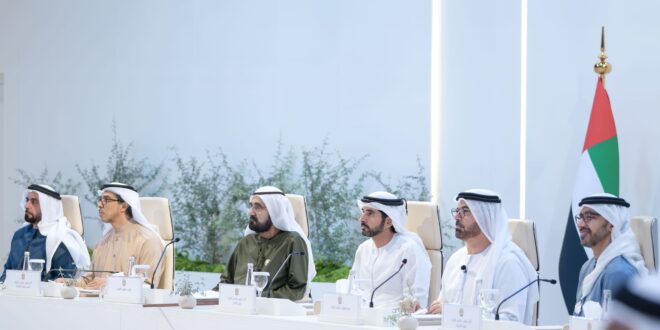
His Highness Sheikh Mohammed bin Rashid Al Maktoum, Vice President, Prime Minister of the UAE, and Ruler of Dubai, has chaired the UAE Cabinet meeting.
The meeting was attended by His Highness Sheikh Mansour bin Zayed Al Nahyan, Vice President, Deputy Prime Minister, and Chairman of the Presidential Court; H.H. Sheikh Hamdan bin Mohammed bin Rashid Al Maktoum, Crown Prince of Dubai, Deputy Prime Minister and Minister of Defence; H.H. Lt. General Sheikh Saif bin Zayed Al Nahyan, Deputy Prime Minister, and Minister of the Interior, and H.H. Sheikh Abdullah bin Zayed Al Nahyan, Deputy Prime Minister and Minister of Foreign Affairs.
His Highness Sheikh Mohammed bin Rashid Al Maktoum said, “I chaired a meeting of the UAE Cabinet at which we reviewed the plan to roll out Mira, the UAE Government Concierge Agent. Mira will be available to everyone using UAE Government services from March 2027… We directed the formation of executive teams to accelerate work on Mira and instructed all federal entities to connect their services to Mira within the timelines approved by the Cabinet.”
His Highness Sheikh Mohammed bin Rashid Al Maktoum added: “We are entering a new phase in how we deliver government services. People will be able to speak to the government in their own language and get the services they need in their own words. They will spend less time on government transactions and have more time for their work.”
His Highness Sheikh Mohammed bin Rashid said: “Today, we approved the first comprehensive government strategy for Agentic AI. We also approved the national technical ecosystem FedAI, a unified, secure and sovereign government platform and infrastructure for developing and running Agentic AI solutions. Our goal is for the UAE Government to be the fastest, the most efficient and the best prepared for technologies of the future.”
He continued, “Today we approved a new framework for joint economic committees between the UAE and countries around the world to strengthen our economic, trade and investment partnerships. We also reviewed the results of the National Investment Strategy. The UAE now ranks among the world’s top ten for foreign direct investment inflows, which reached AED 177 billion in 2025. Our foreign direct investment stock reached AED 1.174 trillion. The UAE economy continues to grow, global confidence in our country is strengthening, and our international partnerships are expanding.”
The Cabinet approved the Strategy for Agentic AI Project, the world’s first government strategy for Agentic AI. The strategy aims to redesign government operations around Agentic AI, develop national talent and provide the highest secure infrastructure for deploying the technology.
It targets a transition to models supported by Agentic AI across 50% of government operations, services and procedures, and the training of 80,000 federal government employees. It also aims to adopt and use at least 90% of Agentic AI models and systems within secure government infrastructure, reduce the time needed to carry out government operations and develop strategies by at least 50%, and improve the quality and accuracy of government outputs by 90%.
The Cabinet approved the launch of FedAI, the national technical ecosystem for Agentic AI. The unified platform gives federal entities a secure, flexible and sovereign environment in which to develop and run Agentic AI solutions. Its National AI Gateway provides a single secure point of access. The platform also enables entities to share solutions, lower development costs and deliver projects faster.
The Cabinet also approved the National Cybersecurity Index, the National Cyber Crisis Management Framework and the National Zero Trust Security Policy. It approved the addition of a dedicated section on AI procurement to the federal government’s financial policies.
The Cabinet reviewed the achievements of the Sheikh Zayed Housing Programme. Since its establishment in 1999, the Programme has issued more than 75,000 housing support decisions worth over AED 54 billion.
The Programme has worked with national banks to develop sustainable financing arrangements. It also introduced an insurance pool to help senior citizens access housing finance by covering the risks of death and total disability, and launched the Housing Bundle to bring related housing services together and simplify the process for citizens.
The Cabinet approved the updated UAE Environment public Policy 2031, which sets a long-term framework for protecting the environment, conserving natural resources and coordinating efforts across the public and private sectors. It also approved the third edition of the UAE State of the Environment Report 2025 and the UAE’s 2025 national report on ozone-depleting substances.
The Cabinet reviewed progress on the UAE Energy Strategy 2050. Installed clean energy capacity reached 13.8 GW in 2025, including 8.2 GW of renewable energy and 5.6 GW of nuclear energy. Clean energy accounted for about 32% of electricity generation, against an updated national target of 35% by 2031.
The Cabinet also reviewed implementation of the National Hydrogen Strategy 2050 and the National Sustainable Aviation Fuel Policy. About AED 41 billion has been earmarked for projects being monitored in hydrogen, its derivatives and sustainable aviation fuel. The Cabinet approved a biodiesel pricing mechanism and the formation of a federal committee to regulate the electricity and water sector, chaired by the Minister of Energy and Infrastructure.
The Cabinet reviewed progress on the National Investment Strategy 2031. The UAE ranked ninth globally for foreign direct investment inflows in 2025. Inflows reached AED 177 billion, equivalent to about 7.9% of GDP, while the UAE’s foreign direct investment stock reached AED 1.174 trillion. The Cabinet was also briefed on the development of the UAE Atlas project and the results of the 2025 Investor Voice survey, which found that about nine in ten respondents intended to invest in the UAE within three years.
The Cabinet approved the National Youth Policy under the National Youth Agenda 2031. The policy aligns national efforts to support young people and focuses on their wellbeing, participation, national identity and readiness for the future.
The Cabinet approved the UAE’s National Charter for Children’s Culture, a common framework for meeting children’s cultural needs, supporting their wellbeing and respecting their cultural values. It recognises children as bearers of national identity and active participants in shaping the UAE’s cultural life. All relevant entities share responsibility for providing every child with a safe and supportive cultural environment.
The Charter sets out ten rights. Every child has the right to access culture, engage with it throughout childhood, develop and take pride in their cultural identity, learn about and through the arts and culture, and enjoy a safe cultural environment. Children also have the right to discover and develop their talents with support, share cultural experiences with others, enjoy high-quality cultural experiences, participate and be heard, and have their cultural rights protected.
National Framework for the Classification, Performance Quality and Oversight of Higher Education Institutions
The Cabinet approved the issuance of a resolution establishing a national framework for higher education institutions and their branches across the UAE, including those in free zones. The framework uses reliable data to classify institutions, assess the quality of their performance and outcomes, and identify risks. Oversight will reflect each institution’s level of compliance and risk, while respecting the mandates of local authorities and coordinating federal and local roles.
The Cabinet approved guidelines to establish a common approach to gender balance across government communications. They set standards for written messages and visual content that give women and men balanced representation, in line with the UAE’s priorities and the values of its society.
The Cabinet approved the issuance of a resolution designating the Emirates Genome Council as the authority responsible for establishing the National Genomic Database and overseeing its data governance. The resolution supports the implementation of Federal Decree-Law No. 49 of 2023 on regulating the use of the human genome.
The database will serve as a national reference for genetic and genomic data.
The resolution sets rules for storing, using and sharing these data, linking them to health and research databases, and publishing genomic research. These safeguards protect privacy while supporting proactive, personalised healthcare and the development of advanced treatments.
The Cabinet also approved the preparation of a federal law on fertilisers, soil conditioners and pesticides, and the issuance of a federal law on the integrated management of environmental protection and development.
The Cabinet approved a new framework for joint economic committees between the UAE and partner countries.
The framework brings joint economic committees under the umbrella of the joint committees and coordinates their work with that of committees for Comprehensive Economic Partnership Agreements. A coordinating committee chaired by the Ministry of Foreign Trade will help accelerate economic, trade and investment initiatives.
The Cabinet also expanded the mandate of the Balance of Payments Committee and renamed it the UAE External Sector Statistics Committee. Chaired by the Minister of Foreign Trade, the committee will oversee statistics on the balance of payments, the international investment position and external debt.
The Cabinet approved the ratification of agreements with Togo on the mutual waiver of entry visa requirements for holders of diplomatic passports, with Ecuador on air services, and with El Salvador on the elimination of double taxation on income and capital and the prevention of tax evasion and avoidance. It also approved the ratification of Universal Postal Union instruments.
The Cabinet approved the launch of an international alliance to advance rain enhancement on the sidelines of the 2026 United Nations Water Conference in Abu Dhabi, and the UAE’s accession to the Committee on Nuclear Regulatory Activities of the OECD Nuclear Energy Agency. It also approved the negotiation and signing of 62 international memoranda of understanding and agreements, reviewed the UAE’s participation in international meetings and conferences, and approved the hosting of 7 regional and international events.