 UAE BARQ برق الإمارات – نبضك
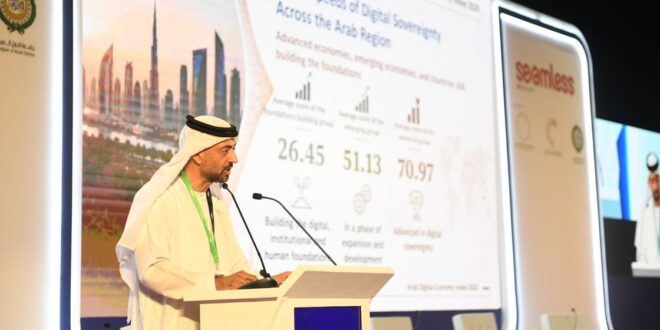
The UAE has topped the Arab Digital Economy Index 2026, whose results were announced on Tuesday as Seamless Middle East 2026 opened in Dubai under the patronage of H.H. Lt. General Sheikh Saif bin Zayed Al Nahyan, Deputy Prime Minister and Minister of the Interior, and Supreme President of the Arab Federation for Digital Economy.
Held at Dubai World Trade Centre from 22nd – 24th September, the event brings together the payments, fintech, banking, digital commerce, retail, identity and logistics sectors, with more than 25,000 participants, around 800 speakers and 750 exhibitors.
The opening session drew Arab and international diplomatic, government and institutional representatives, including ambassadors and delegates from Egypt, Oman, Qatar, Lebanon, Mauritania, Tunisia, Syria, Djibouti and Palestine, alongside Russian representatives and officials from international and regional organisations.
UAE government, economic, financial and academic officials also attended, along with representatives of the finance, energy, customs and economic development sectors, banks, chambers of commerce, research and innovation centres and international organisations.
The opening programme featured an address by Dr. Ali Mohammed Al-Khouri, Chairman of the Board of Directors of the Arab Federation for Digital Economy and Advisor to the Council of Arab Economic Unity, followed by the launch of the Arab Digital Economy Index 2026.
Officials from the Sharjah Research, Technology and Innovation Park and the UAE Banks Federation also addressed the event before delegates toured the exhibition.
The index assesses digital-economy performance across a framework covering institutions, infrastructure, workforce, digital government, innovation, knowledge and technology, market forces, capital-market growth and sustainable development.
The UAE led the highest-performing group, which also included Saudi Arabia, Bahrain, Qatar and Oman.
The second group, comprising countries with medium levels of performance, included Jordan, Kuwait, Morocco, Egypt, Tunisia and Algeria. The third group, representing countries in the process of building their digital foundations, comprised Lebanon, Mauritania, Iraq, Djibouti, Comoros, Libya, Palestine, Syria, Sudan, Somalia and Yemen.
The results showed stronger progress across the Arab world in digital infrastructure, government services and cybersecurity, while wider gaps remained in innovation, the data economy, research and development, and the ability to translate digital investment into productivity and economic value.
Al-Khouri said the latest edition of the index places digital sovereignty at the heart of discussions on the future of Arab economies, as data, artificial intelligence, cloud infrastructure, semiconductors and cybersecurity become increasingly important to countries’ economic and institutional capabilities.